

 Search
 EN
 Text Size
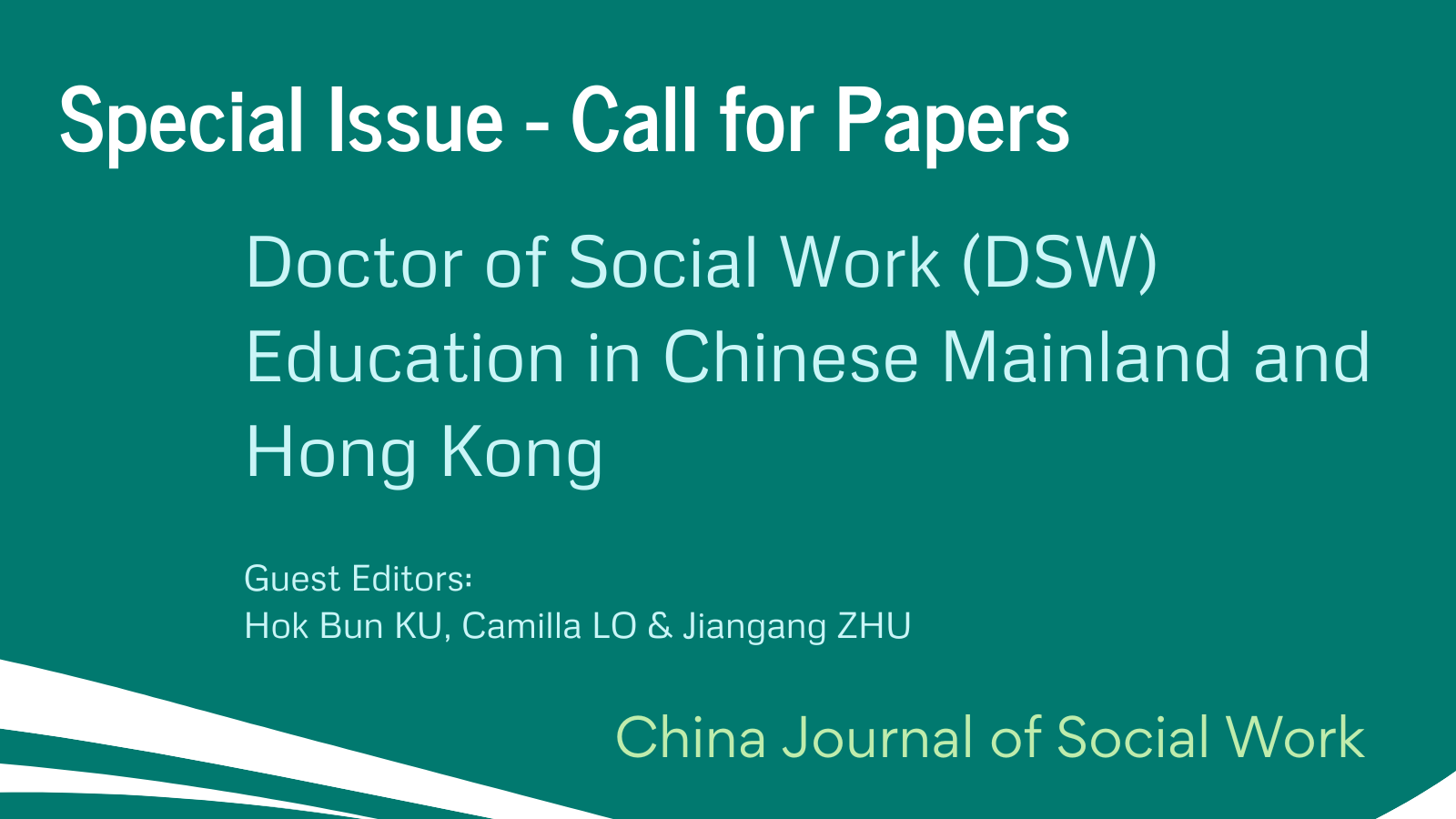
[Special issue - Call for papers] Negotiating Legitimacy: Medical Social Work in Clinical Settings across Chinese Societies
 30 Jun 2027
Learn More



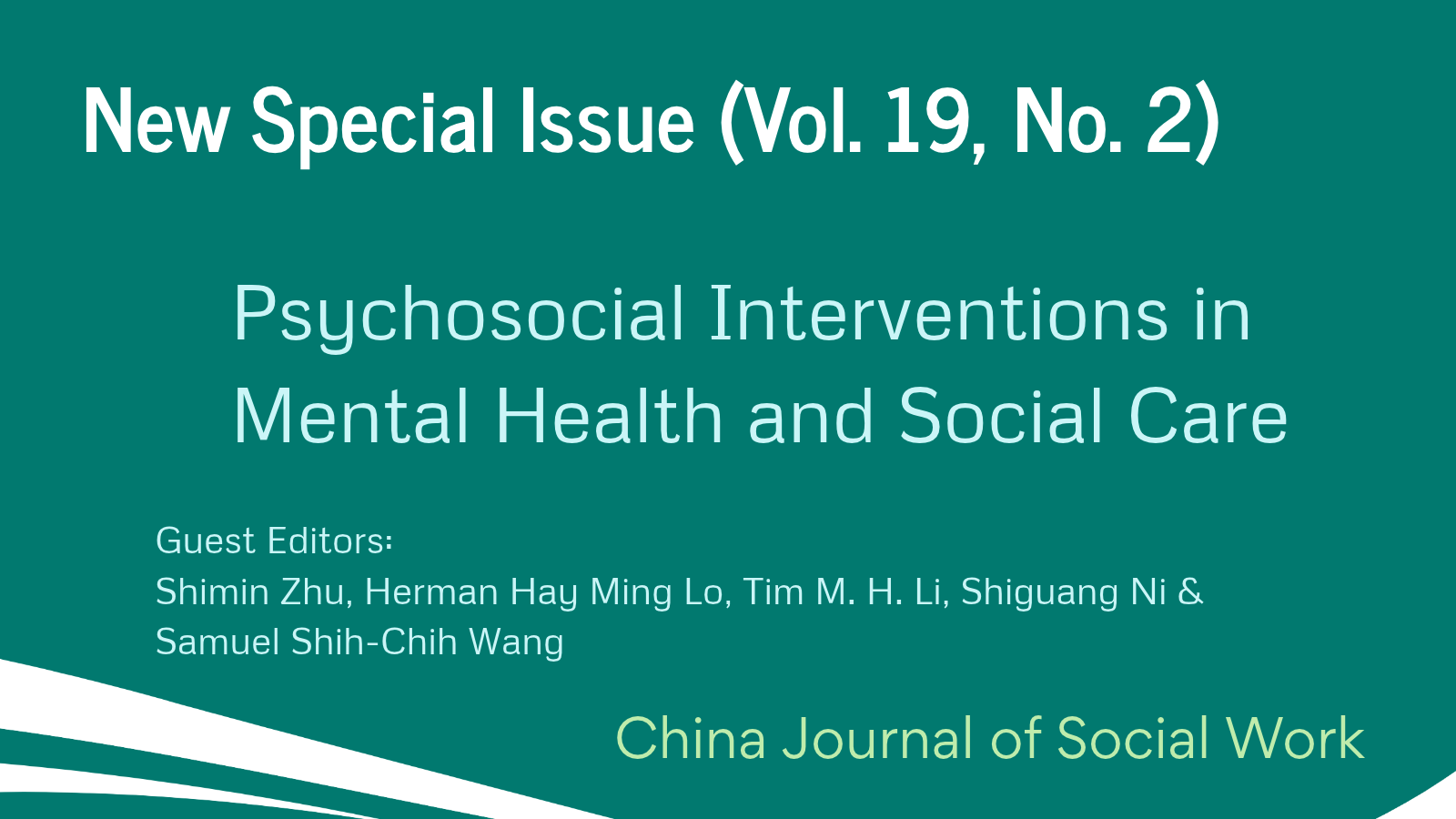
The special issue of the China Journal of Social Work, “Psychosocial Interventions in Mental Health and Social Care” (Vol. 19, No. 2), was previously published online. It was edited by our APSS, PolyU colleagues, Shimin Zhu and Herman Hay Ming Lo, together with Tim M. H. Li, Shiguang Ni, and Samuel Shih-Chih Wang. This special issue brings together six papers that advance psychosocial practice and innovation across diverse populations, intervention approaches and cultural contexts. Collectively, the contributions highlight contextually grounded and socially responsive models of care that strengthen agency, connection, and well-being in communities, families and educational settings.
Below, we present the abstracts of the articles featured in this issue. We hope this special issue contributes to ongoing scholarly dialogue and advances research and practice in psychosocial interventions in mental health and social care.
Editorial
Link: https://doi.org/10.1080/17525098.2026.2739499
Written by Shimin Zhu, Herman Hay Ming Lo, Tim M. H. Li, Shiguang Ni & Samuel Shih-Chih Wang
Articles
Bridging the service gap: co-producing an intervention framework for rural children in families with severe mental illness
Link: https://doi.org/10.1080/17525098.2026.2738629
Written by Bo Li, Aiqin Pu, Yunhua Yan, Sihao Choy, Diwen Zhang, Jun Li & Juan Chen
Abstract: This study confronts the persistent fragmentation of services for children in rural Chinese households affected by severe parental mental illness. Through a collaborative knowledge production process in a rural county of Southwestern China, we integrated frontline social work wisdom with academic enquiry to develop a whole-process intervention framework. Organised around a recursive cycle of identification, intervention, follow-up, and exit, and animated by practice principles of flexibility, family-centredness, repetition, and comprehensiveness, the framework seeks to strengthen service continuity, systemic coherence and local responsiveness. Situated within integrated care theory, systems thinking, and the innovative care for chronic conditions model, our analysis pushes beyond social-worker-dependent, episodic interventions towards integrated, systemic support. We advocate for cross-sector collaboration, frontline capacity building, family empowerment, and the cultivation of a triangular support ecology connecting communities, service teams and families.
Effects of a drumming programme on improving well-being of people with severe spinal cord injuries
Link: https://doi.org/10.1080/17525098.2026.2742310
Written by Tse Chiu Chan & Herman Hay Ming Lo
Abstract: Psychological intervention for individuals with severe spinal cord injuries is limited. Holyoake DRUMBEAT® group interventions have been shown to enhance well-being and mental health. This study employed a mixed-methods approach, incorporating a randomised waitlist control group design to evaluate programme outcomes, alongside a focus group interview to delve into participants’ experiences. A total of 20 participants were enrolled, randomly assigned to either the drumming group or the waitlist control group. Participants completed outcome measures at baseline (T0), post-intervention (T1), and at an eight-week follow-up (T2). A focus group interview was conducted 15-week post-intervention. Significant Time × Group effects were observed for psychological well-being, self-esteem, and perceived stress, with improvements sustained during the follow-up period. Participants in the focus group interview reported changes in their social interactions, mental well-being, and personal beliefs. The study provides initial evidence to support the effectiveness of a drumming programme for adults with severe spinal cord injuries.
Five steps to interpersonal connection: implementing the STE2P Communication Technique in Taiwanese dementia care
Link: https://doi.org/10.1080/17525098.2026.2723809
Written by Yi-Ling Wu, Samuel Shih-Chih Wang & Chien-Liang Liu
Abstract: Effective communication in dementia care requires emotional attunement and relational awareness. The STE2P Communication Technique – Smile, Thanks, Eye Contact, Embracing the Moment, and Patience – was developed in Taiwan as an emotionally sequenced framework to support caregiver-patient engagement. Utilising a retrospective pedagogical enquiry, this study evaluates the instructional dynamics and learning patterns of 117 students in a university-based training module. Findings indicate that STE2P facilitated learners’ transitions from correction-focused communication towards emotionally grounded interaction. Patience emerged as a relational outcome rather than a personal trait. The study highlights the model’s pedagogical feasibility and cultural resonance, suggesting that STE2P offers a culturally congruent, accessible communicative heuristic. Its procedural clarity supports integration into social prescribing pathways, equipping non-clinical stakeholders with practical skills for community-based dementia care.
Horticultural therapy in social work: improving ADHD-related behavioural tendencies among Chinese migrant children
Link: https://doi.org/10.1080/17525098.2026.2743410
Written by Weidi Yang & Xiao Liang
Abstract: This study examined the feasibility and short-term effects of horticultural therapy for ADHD-related behavioural tendencies among Chinese migrant children within a social work framework. Twelve children participated in a non-equivalent comparison-group study, with six receiving an eight-session, school-based horticultural therapy programme and six serving as controls. Activities combined plant cultivation, floral design, multisensory experiences, symbolic emotional expression, and group cooperation. Parent- and teacher-rated behavioural tendencies were assessed at four pre-intervention time points and after the programme. Repeated-measures ANOVA showed significant time-by-group interactions, with reductions in inattention, hyperactivity, learning difficulties, impulsivity, problem behaviours, and overall ADHD-related tendencies in the intervention group relative to controls. The findings suggest that structured horticultural therapy may provide a feasible, low-stigma approach to supporting behavioural regulation and social adaptation among migrant children, while larger controlled studies are needed to establish its effectiveness.
Motor and exercise-based interventions for children with ASD: a comparative review of delivery models and implications for psychosocial interventions
Link: https://doi.org/10.1080/17525098.2026.2743435
Written by Yi-Ling Wu, Chien-Liang Liu & Samuel Shih-Chih Wang
Abstract: Motor impairments are common among children with autism spectrum disorder (ASD), limiting participation in educational, social, and community contexts. Although motor and exercise-based interventions for children with ASD are widely studied, differences in delivery models and their implications for psychosocial interventions remain insufficiently synthesised. This narrative review adopts a comparative perspective to examine motor and exercise-based interventions for children with ASD, focusing on how different delivery models shape participation-related and social experiences. Interventions are grouped into four categories: (1) traditional motor interventions delivered within healthcare (e.g. physical and occupational therapy); (2) structured exercise-based programmes; (3) group-based sports and recreational activities; and (4) technology-assisted or digital interventions. Rather than comparing quantitative effect sizes, this review emphasises implications for psychosocial interventions related to participation opportunities, social engagement, and contextual fit. Findings are interpreted within the educational and healthcare systems in Taiwan, highlighting implications for interdisciplinary practice and policy development.
Recognition and management of late-life depression in Chinese primary care: a narrative review on evidence-based strategies for community practice
Link: https://doi.org/10.1080/17525098.2026.2717209
Written by Guosheng Peng & Haiyan Xie
Abstract: Late-life depression is highly prevalent yet severely underdiagnosed among older adults in Chinese primary care settings. This narrative review synthesised evidence from 82 high-quality sources, with publication years spanning 1983 to 2024, identified through systematic searches of PubMed/MEDLINE, Web of Science, the Cochrane Library, CNKI, Wanfang, and VIP databases. The findings support culturally adapted strategies for community practitioners, including validated screening tools (e.g. the Chinese version of the Patient Health Questionnaire-9 (PHQ-9) with an optimal cut-off of 6–8, and the Chinese version of the Geriatric Depression Scale-15 (GDS-15) with a cut-off of 5–7), a stepped-care treatment model integrating selective serotonin reuptake inhibitors (SSRIs; “start low, go slow”), problem-solving therapy, and Traditional Chinese Medicine (e.g. Tai Chi). Collaborative care models are also recommended to improve detection and management. Success hinges on addressing stigma, involving families, and integrating evidence-based Western and traditional approaches to reduce the treatment gap in China’s ageing population.
Book Review
Sanjuguer de duochongnijing yu kangnili yanjiu [A study of multiple adversities and resilience of orphans living in dispersion]
Link: https://doi.org/10.1080/17525098.2026.2731906
Book author: Yongbing Yan
Book reviewer: Shuling Gao
Navigating family estrangement: helping adults understand and manage the challenges of family estrangement
Link: https://doi.org/10.1080/17525098.2026.2734016
Book author: Karl Melvin
Book reviewer: Zhenrong Su