


 Search
 EN
EN Text Size
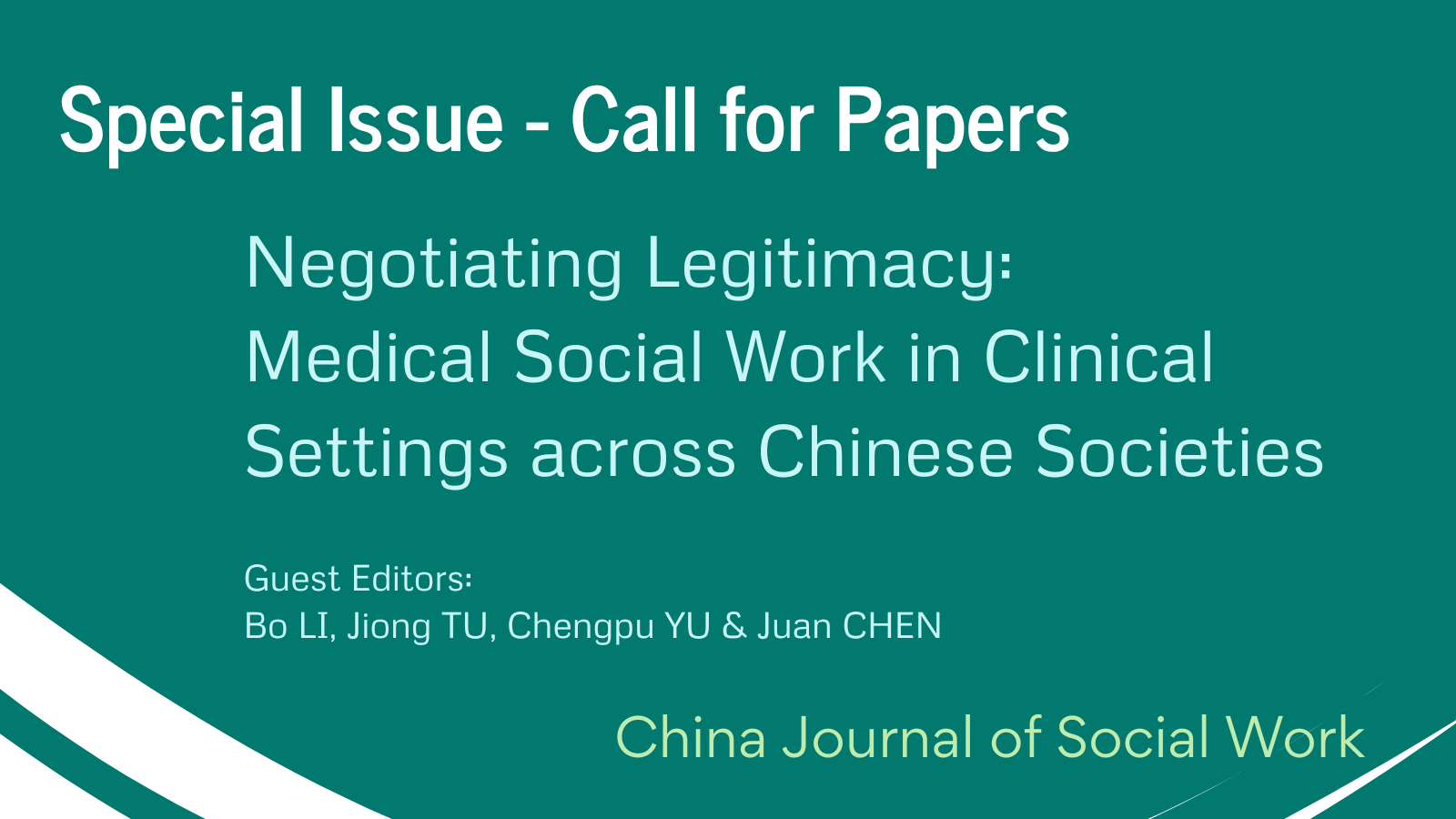
[Special issue - Call for papers] Negotiating Legitimacy: Medical Social Work in Clinical Settings across Chinese Societies
 30 Jun 2027
Learn More



Rationale
The legitimacy of medical social work in clinical settings refers to the professional recognition, institutional acceptance, and operational authority that social workers hold, or seek to attain, within healthcare systems historically organised around biomedical priorities. Legitimacy is not merely a matter of formal credentials or job titles; it is enacted daily through documentation, interdisciplinary meetings, and bedside interactions, where medical social workers continuously justify their presence, define their scope, and demonstrate their distinct contributions to patient care. For clinical practice, legitimacy shapes whether social workers are consulted early or late, whether their assessments inform treatment planning, and whether their interventions are adequately resourced. Without it, medical social workers risk being “relegated” to discharge planning or crisis-only functions; with it, they can address the full biopsychosocial spectrum, including mental health crises, family conflict, care transitions, and advance care planning, among others (e.g. palliative counselling, financial resource navigation, caregiver support). In Chinese societies, where healthcare reform proceeds amid entrenched medical hierarchies, divergent regulatory landscapes, implementation gaps, and ambiguous scope-of-practice definitions, the question of medical social work legitimacy carries urgency.
Aims and Scope
This Special Issue aims to advance theoretical and empirical understanding of medical social work legitimacy in clinical settings across Chinese societies. Rather than treating legitimacy as a fixed attribute or binary status, we conceive of it as dynamic and contested – shaped by institutional structures, professional interactions, policy environments, and discursive practices. Our goal is to assemble papers that illuminate these dimensions, attending equally to constraints and agency.
We invite contributions that engage with legitimacy through – though not limited to – one or more of the following lenses:
We welcome diverse methodological approaches, including but not limited to case studies, comparative analyses, policy reviews, historical analyses, discourse analysis, and mixed-methods designs. Theoretically, we invite diverse frameworks, including but not limited to institutional theory, boundary work, symbolic interactionism, and field analysis, that illuminate the construction, negotiation, or contestation of legitimacy. Geographically, we invite contributions from or about the Chinese Mainland, Hong Kong, Macau, Taiwan, and other Chinese-majority or diaspora societies where medical social work operates in clinical contexts.
Why Submit?
Submission Guidelines
Publication schedule: April 2028; Volume 21, Issue 1; Accepted papers will be published online first.
Guest Editors
Dr Bo LI
The Hong Kong Polytechnic University
Prof. Jiong TU
Sun Yat-sen University
Prof. Chengpu YU
Sun Yat-sen University
Prof. Juan CHEN
The Hong Kong Polytechnic University
Contact Us
For general enquiries, please call +852 2766 7725, or send an email to [email protected].
![[Special issue - Call for papers] Doctor of Social Work (DSW) Education in Chinese Mainland and Hong Kong](/uploads/image/202610/2e5066721054968aad85c1270a609773.png)
![[Special issue - Call for papers] Social Work Practitioners Conducting Research in Chinese Societies: Bridging Theory and Practice in Changing Context](/uploads/image/202606/6fbab7874fd2e78828bcdb6a5ca35ae5.png)